Generative AI for Contact Centers: What the ROI Data Shows So Far

Every contact center leader has seen the same two headlines in the same week: generative AI is cutting costs by double digits at one company, and failing to move the needle at another. Both are true. The question worth asking about generative AI for contact centers is not whether it works. It is which deployments produce measurable returns, and why the rest do not.
This post works through the independent research, not vendor talking points, to answer that question.
Key data points at a glance
- A National Bureau of Economic Research (NBER) field study of 5,179 customer support agents found generative AI assistance increased issues resolved per hour by 14% on average, with a 34% gain for newer agents.
- MIT’s Project NANDA found that 95% of enterprise generative AI pilots showed no measurable profit-and-loss impact, based on an analysis of 300 deployments.
- Gartner has projected that at least 30% of generative AI projects will be abandoned after proof of concept, and that over 40% of agentic AI projects will be canceled before 2027.
- McKinsey estimates generative AI can reduce human-handled service volume by up to 50% in sectors like banking and telecom, while lifting customer operations productivity by 30% to 45% of the function’s total cost.
- IBM research puts the share of AI projects that deliver their promised ROI at roughly one in four, with only 16% scaled across the enterprise.
Adoption is nearly universal. Returns are not.
Generative AI adoption in customer service is no longer the open question it was two years ago. Most contact centers report using some form of AI, and Gartner’s 2025 target of 80% adoption among customer service organizations has largely been reached. The gap has moved downstream, from “are you using AI” to “is it paying for itself.”
That gap is wide. MIT’s Project NANDA, in its 2025 report “The GenAI Divide: State of AI in Business,” analyzed roughly 300 enterprise AI deployments alongside more than 150 executive interviews and found that 95% delivered no measurable financial impact. Only 5% of pilots translated into real operational or revenue outcomes. A separate S&P Global survey of more than 1,000 enterprises found that 42% had abandoned the majority of their AI initiatives before production, up from 17% the year before. RAND Corporation’s research on AI project outcomes puts the overall failure rate above 80%, roughly twice the rate seen in non-AI technology projects.
None of this means generative AI does not work in a contact center. It means most organizations are not yet capturing the value that the technology is capable of producing, and the reasons are more organizational than technical.
Where the ROI data actually holds up
The most rigorous evidence available comes from a controlled study, not a survey. Economists Erik Brynjolfsson, Danielle Li, and Lindsey Raymond tracked the staggered rollout of a generative AI conversational assistant across 5,179 customer support agents at a large company (published as NBER Working Paper 31161, and later in the Quarterly Journal of Economics). Agents with access to the tool resolved 14% more issues per hour on average. The gain was far larger, 34%, among newer and lower-skilled agents, while experienced agents saw little change. The researchers also found improvements in customer sentiment and agent retention.
That pattern, generative AI helping the least experienced workers the most, shows up again in McKinsey’s research on customer operations. McKinsey estimates that generative AI can cut human-serviced contact volume by up to 50% in banking and telecom, and can lift the productivity of the customer operations function by an amount equal to 30% to 45% of its total cost. Those figures describe an assisted model, an AI system supporting a human agent or handling a defined slice of routine volume, not a fully autonomous replacement for the contact center.
This distinction matters for anyone building a business case. The deployments with the clearest, most independently verified ROI are the narrower ones: agent-assist tools, summarization, guided responses, and defined self-service flows. The claims that tend to collapse under scrutiny are the broader ones, full end-to-end automation promised to replace large blocks of headcount on a fixed timeline.
Why the returns are so uneven
Adoption statistics can be misleading on their own. Most contact centers report using AI in some form, but a much smaller share, often cited around one in four, have moved it past a pilot into a fully integrated part of daily operations. IBM’s research reflects the same divide: roughly one in four AI projects delivers on its promised ROI, and just 16% get scaled across the enterprise.
MIT’s research points to specific, recurring causes rather than a single explanation:
- Budget misallocation. More than half of generative AI spend in the period MIT studied went to visible, front-office pilots such as sales and marketing tools, while the back-office and operational use cases, the ones with the clearest cost-to-serve impact, were comparatively underfunded.
- Static tools in dynamic workflows. Pilots that could not retain feedback, adapt to context, or improve from real interactions tended to stall regardless of the underlying model’s quality.
- Build-versus-buy mismatches. Projects that combined internal domain expertise with outside implementation partners succeeded at roughly three times the rate of projects built entirely in-house, according to MIT’s analysis.
- Weak measurement. Many pilots lacked a documented pre-deployment baseline, which made it difficult to demonstrate impact even where real gains existed.
Gartner’s forward-looking numbers reinforce the pattern: at least 30% of generative AI projects are projected to be abandoned after proof of concept, and more than 40% of agentic AI projects are expected to be canceled before the end of 2027, largely due to rising costs, unclear business value, or inadequate risk controls.
The cost-per-resolution reality check
Vendor materials commonly cite a sharp drop in cost per interaction, often from a range of $6 to $12 for a human-handled contact down to $1 to $2 for an AI-handled one. Those figures come from vendor benchmarking, not independent research, and they hold up best in narrow, high-structure use cases such as order status or password resets. They hold up far less well for sentiment-heavy or multi-step interactions, where an AI system that fails to resolve the issue simply shifts the cost to a human agent handling an escalation, plus a frustrated customer.
Gartner’s own longer-range projection adds a useful caution: by 2030, the cost per resolution for generative AI is expected to rise past $3 as compute and licensing costs increase, a figure that could approach or exceed the cost of some offshore human agent models. The lesson is not that generative AI is not worth deploying. It is that a cost-per-resolution figure only means something when it is measured against a comparable, resolved interaction, not against raw contact volume.
What separates the deployments that pay off
Across the independent research, a consistent profile emerges for the contact center deployments that produce durable ROI.
- They start narrow and scoped. The organizations MIT classified as top performers moved from pilot to full implementation in an average of 90 days, a pace made possible by picking a specific, well-bounded use case rather than attempting to automate the entire interaction lifecycle at once.
- They keep a human escalation path. The NBER study’s productivity gains came from an assist model, not a replacement model. The agent remained in the loop, which limited downside risk while still capturing the upside.
- They measure quality, not just volume. The deployments that survive an executive review are the ones that can show whether the AI-handled interaction actually resolved the customer’s issue, stayed within compliance guardrails, and protected the relationship, not just that it kept the customer out of the queue.
- They apply the same standard to AI-handled interactions as human ones. When AI-driven conversations are scored against a different, looser bar than human-handled ones, the resulting ROI numbers are not comparable to begin with, and they rarely survive a second look from finance or compliance.
That last point is where most of the reported “GenAI Divide” actually lives. Organizations that can point to a documented baseline, a consistent scoring standard, and a resolution-quality metric, not a deflection metric, are the ones building a case that holds up. Organizations relying on volume-handled or contacts-deflected numbers alone tend to be the ones whose pilots quietly disappear a year later.
A practical starting point
For a contact center evaluating its own generative AI business case, the data above points to a short list of questions worth asking before signing a contract or greenlighting a scale-up:
- Is the pilot scoped to a specific, well-defined use case, or is it attempting to automate an entire interaction type end to end?
- Is there a documented pre-deployment baseline for cost, resolution rate, and quality score to compare against?
- Are AI-handled interactions scored against the same quality and compliance standard as human-handled ones?
- Does the reported cost-per-resolution figure account for interactions that were escalated to a human agent after the AI attempt failed?
- Is there a human escalation path built in, rather than a fully autonomous handoff with no oversight?
Contact centers that can answer all five with confidence are the ones most likely to be counted among the 5% MIT identified, not the 95%.
FAQ: Generative AI ROI in contact centers
What is the average ROI of generative AI in contact centers?
There is no single average that applies across deployments. The most reliable independent data point is a 14% average productivity gain (issues resolved per hour) from a controlled study of 5,179 agents, rising to 34% for newer agents. Broader cost-savings claims of 20% to 50%, most often from vendor sources, are typically tied to narrow, high-structure use cases rather than full contact center operations.
Why do most generative AI pilots fail to show ROI?
MIT’s research points to a small number of recurring causes: spending concentrated in visible but low-impact areas, tools that cannot learn from real interactions, in-house builds without outside implementation expertise, and a lack of a documented baseline to measure against.
How long does it take to see ROI from generative AI in a contact center?
Among the top-performing organizations MIT studied, the average time from pilot to full implementation was about 90 days. That pace was tied directly to keeping the initial use case narrow rather than attempting a full-scale rollout from the start.
Does generative AI reduce contact center costs?
It can, in specific, well-scoped use cases. McKinsey estimates a reduction in human-serviced contact volume of up to 50% in banking and telecom, alongside a productivity lift equal to 30% to 45% of the customer operations function’s cost. Those gains come from an assisted model, not full automation, and they depend on measuring resolved outcomes rather than raw volume handled.
What metrics should contact centers track to measure generative AI ROI?
Resolution quality and compliance, scored on the same standard used for human agents, alongside cost per resolved issue rather than cost per contact, and a documented pre-deployment baseline. Deflection or volume-handled numbers on their own do not reflect whether the customer’s issue was actually resolved.
Where the measurement gap gets closed
The research above points to one consistent finding: the contact centers building a credible generative AI business case are the ones measuring AI-handled interactions with the same rigor they apply to their human agents, not a separate, looser standard built for a pilot.
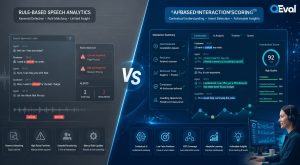
That is the gap QEval® is built to close. QEval scores generative AI and human-handled interactions against the same scorecard, so quality and operations leaders can see, in one place, whether an AI-driven conversation actually resolved the issue, stayed compliant, and protected the customer relationship, alongside the human interactions it sits next to.
See how QEval scores AI-handled and human-handled interactions on one standard at qeval.ai.
Manu Dwievedi
Manu joined Etech in March 2014 as an Online Chat Representative. During his tenure, Manu has held responsibilities in various facets of call center, including operations, training as well as quality monitoring & analytics. Manu is driven and passionate about customer experience management, data science, natural language processing, machine learning, and driving innovative conversational AI solutions for business growth.